
At kiutra, we make cryogenics accessible by removing barriers to extremely low temperatures with our systems and services
Quantum computers can solve highly complex problems that exceed the capabilities of classical systems, for example in chemistry, pharmaceuticals, logistics, finance, or mechanical engineering. To do so, they require temperatures close to absolute zero (−273.15 °C).
Conventional cooling methods are costly, technically complex, and dependent on the rare isotope helium-3. This limits scalability and creates geopolitical dependencies for research and industry.
For quantum systems to scale, a different approach to cooling is needed – solid-state, magnetic cooling generates the ultra-low temperatures required without the use of helium-3.
This reduces dependencies in critical supply chains, lowers operational effort and costs, and accelerates innovation cycles. At the same time, operation and deployment are simplified.
Developing quantum computers relies on fast and easy access to ultra-low temperatures. We provide it through the fastest cooling equipment and services on the market:
Hannover Messe demo: L-Type Rapid
Super-fast characterization for quantum research, training and quality control
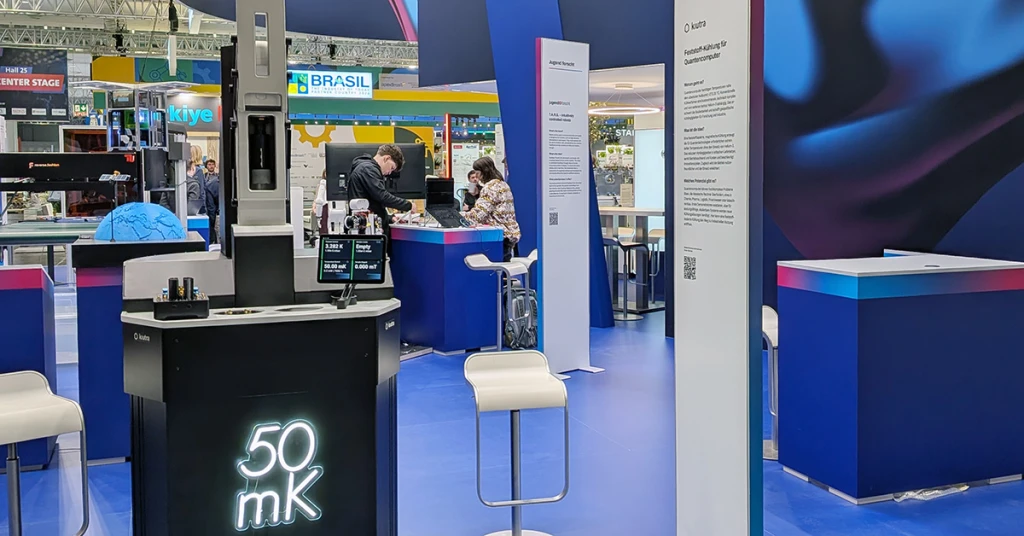
The L-Type Rapid provides fast, cost-effective access to cryogenic temperatures.
Automated sample loading and simplified operation maximize efficiency to take the maintenance and wait times out of low-temperature characterization.
SPROUT
Solid-state cooling for quantum computers
The SPROUT project, a partnership between kiutra and Delft Circuits, set out to deliver a fully integrated, helium-3-free cooling system for quantum component testing and multi-node quantum networks. The system achieved continuous operation below 30 mK, reached 20 mK on the kiutra lab testbed in 2024 — shipping systems specify 50 mK — and integrated into a compact rack format suitable for data center deployment, with extensive wiring capacity and enough cooling power to operate superconducting qubit chips.
Results were published in Review of Scientific Instruments in 2026, demonstrating that continuous magnetic cooling can deliver the stability and integration density quantum computing requires, without dependence on scarce cryogenic resources.
SPROUT received funding from the Eurostars program with co-funding by EUREKA member countries and the European Union Horizon 2020 research and innovation program and the German Federal Ministry of Education and Research.
LEMON
Large-scale magnetic cooling
The focus of the LEMON project is to develop a scalable, helium-3-free cryogenic cooling solution capable of reaching millikelvin temperatures. By pushing the limits of continuous Adiabatic Demagnetization Refrigeration (cADR), it will address the growing cooling demands in quantum technologies, particularly in quantum computing.
We will design and investigate a modular system capable of large-scale refrigeration with high cooling capacities.
SPROUT established the foundation for the X-Type, a new cooling architecture for scalable quantum systems. This is now being further developed within the LEMON project.
LEMON is funded as part of an EIC Pathfinder Challenge.
Every quantum computer relies on a cooling system. We build the only one that is independent of helium-3 supply and therefore scalable:
The cooling architecture for scalable quantum systems: X-Type
Beyond the limits of conventional cooling
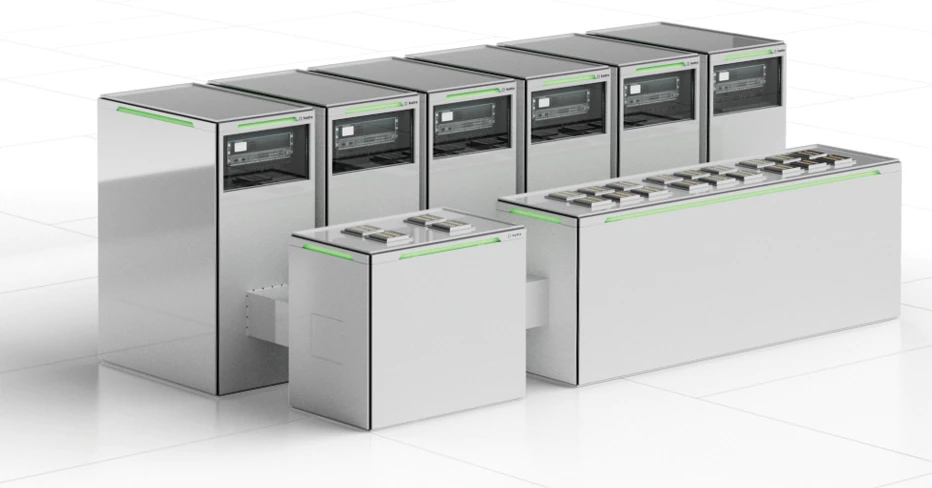
As qubit counts increase, cryogenic requirements grow faster than conventional cooling technologies can handle. What works at hundreds – or even thousands – of qubits becomes structurally limiting at larger scales. Quantum computing doesn’t need incremental cooling improvements. It needs architectural change.