Product release
kiutra announces the X-Type: the modular cooling architecture for scalable quantum systems
Announced at the APS Global Physics Summit: cooling power and payload capacity scale as separate modules, so needing more of either no longer means replacing the system.
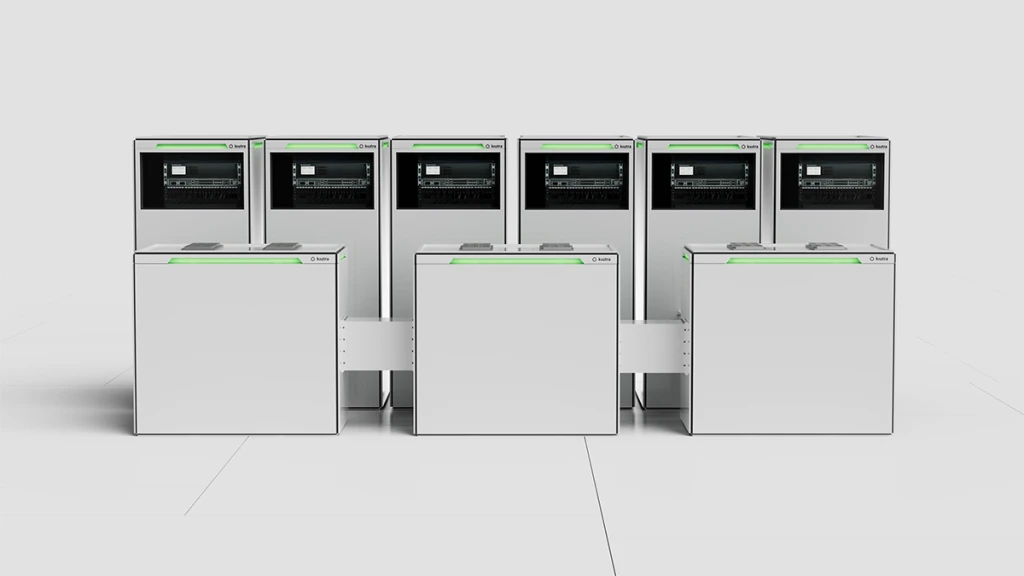
Based on kiutra’s magnetic refrigeration technology, the X-Type introduces independently scalable cooling and payload modules, making it the first millikelvin architecture built to grow with quantum computing.
At the APS Global Physics Summit, kiutra announced the X-Type, the modular cooling architecture for scalable quantum systems. Built on a fully modular architecture, the X-Type makes scalability a core capability through modules that can independently expand cooling power and payload capacity without redesigning the system.
As more and more powerful quantum computers are being deployed, quantum processors (QPUs) are also growing in qubit count and complexity. For cryogenic systems, this means significant increases in the number of cryostats and even greater cooling and payload requirements that can quickly render existing infrastructure obsolete. Conventional cryostats tightly couple cooling power and experimental payload, making upgrades costly, slow, and difficult to scale. To keep pace with the rate of QPU innovation, cryogenic infrastructure must adopt a fundamentally different approach.
The X-Type breaks this limitation by housing cooling power and payload within independent modules. Cooling modules can be added to increase thermal performance without interfering with payload infrastructure, and payload modules can expand line density and usable volume independently from the cooling side. This modular cryogenic approach removes the ceiling on scaling, allowing cryogenic infrastructure to grow with processor complexity.
“Scaling quantum computing requires rethinking cryogenic infrastructure from the ground up. The X-Type lets customers expand cooling capacity module by module, in step with their quantum hardware — without replacing the infrastructure they’ve already deployed.”
Dr. Steffen Säubert, Senior Research & Innovation Lead, kiutra
The X-Type is designed for operational efficiency as much as scalability. The separation between cooling and payload modules enables independent access to the quantum processor, wiring, and electronics, without interfering with the cooling infrastructure. Front-access installation and service further simplify payload work, reducing the labor overhead inherent in tightly integrated, monolithic cryostat designs.
The X-Type base configuration is delivered as one payload module and two cooling modules with the following specifications:
– 20 µW cooling power at 20 mK
– 12 mK base temperature
– Up to 768 lines payload
Beyond modularity, the X-Type is the first quantum cooling architecture of its kind to operate without helium-3. As quantum processing scales, helium-3 supply constraints and geopolitical sourcing pressures are compounding an already complex challenge. Rather than mitigating dependence, kiutra eliminates it by building on continuous adiabatic demagnetization refrigeration (cADR), a magnetic cooling process developed into a continuous, application-ready millikelvin cooling method.
“While the industry works to mitigate its helium-3 dependence, we made a different choice years ago: eliminate it entirely. The X-Type is the result of that decision, the first cooling architecture built from the ground up to scale with quantum computing, without pumps, pipes, and compromise.“
Dr. Alexander Regnat, CEO, kiutra
The X-Type was presented at the APS Global Physics Summit, with first deployments in 2027. Early access and priority terms are available through kiutra’s Beta Partner Program. Explore the X-Type and apply for the Beta Program.
About kiutra:
Since 2018, kiutra has been committed to accelerating quantum breakthroughs and scientific research through fast and easy access to kelvin and millikelvin temperatures. Our cryostats and services are advancing tomorrow’s quantum technologies through scalable systems that offer the fastest available cooldown times, simplified sample loading processes, and an eliminated dependency on scarce helium-3.