


Application note
Fast fabrication feedback for manufacturing of superconducting thin-films
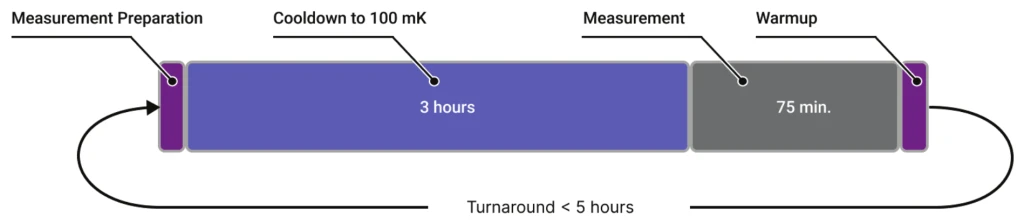
We present a measurement of the critical temperature of a superconducting thin-film sample using a kiutra L-Type Rapid fast turnaround cryostat and a Zurich Instruments MFLI Lock-In Amplifier. The combination of both devices allows us to characterize the thin-film resistivity change down to millikelvin temperatures within less than 5 hours, including sample cooldown, measurement and warmup times.
Keywords: Thin-Film Superconductors; Cryogenic Superconductivity Measurements; Nanofabrication of Superconducting Quantum Devices; Quantum Materials and Superconducting Films Characterization.
Products: kiutra L-Type Rapid, Zurich Instruments MFLI.
Introduction
With the rise of quantum technologies, structured devices made of superconducting materials have emerged as building blocks for superconducting qubits, as well as for quantum sensing and metrology applications. Numerous factors, including fabrication techniques and environmental conditions during processing can significantly impact the properties of superconducting thin-films. This makes the fast characterization of samples a strict requirement for implementing more complex devices, and an ideal tool for the research on novel materials.
The critical temperature (Tc) is the key parameter that defines the properties of superconducting thin-films, marking their transition to a superconducting state. With typical Tc values between 0.1 K and 10 K, cryogenic temperatures well below 1K, as well as precise measurement electronics are required to resolve the superconducting transition. Such measurements are therefore typically performed in dilution refrigerators.
However, dilution refrigerators have the disadvantage of very long turnaround times and are not suited for temperature dependent studies over a broad temperature range. This severely slows down the research on novel materials and prohibits quick fabrication feedback across the multiple steps involved in on-chip superconducting device manufacturing.
In this study we use a kiutra L-Type Rapid (LTR) cryostat in combination with a Zurich Instruments MFLI Lock-in amplifier to demonstrate the fast and automatic investigation of a superconducting thin-film at temperatures between 100 mK and 10 K. We demonstrate that, thanks to the fully automatic operation and fast cooldown of the LTR and the fast data acquisition of the MFLI, the complete investigation of the thin-film, including sample preparation, cooldown, measurement and warmup can be achieved in less than five hours, marking a distinct speed-up compared to traditional characterization methods.
Measurement plan
We demonstrate a quick and effective method for characterizing the superconducting properties of a thin film material, in this case, Titanium-Nitride (TiN) deposited via pulsed DC magnetron sputtering onto a Si (100) substrate. To probe the superconducting properties of the sample, we place it in a temperature-controlled environment and measure its sheet resistance in a four-point configuration. The goal is to identify Tc, as well as any potential residual resistivity within the superconducting phase.
First, we mount the sample on a kiutra sample carrier PAD32 with electrical connections to it made of four co-linear Aluminum bond wires. The PAD32 sample carrier has a 10 x 10 mm cutout in which the sample is glued onto a gold-plated, high-purity oxygen-free copper (OFHC) surface using GE Varnish. The carrier provides an optimized pad layout to contact up to four samples at a time in a four-probe configuration. Next, we mount the sample carrier onto a kiutra Puck 36, which automatically mates with the on-puck DC connectors.
When loading the puck into the cryostat, the pucks’ DC lines mate with the internal cryostat twisted-pair DC wiring. The cryostat DC lines are sized AWG 38 wire and made of enameled copper for the loom installed between room temperature and the 4 K plate, and of NbTi for the loom installed between 4 K plate and the low-temperature stage. At the top plate, the DC lines are broken out into two D-Sub 25 connectors which are plugged into kiutra’s dedicated BNC breakout boxes using two 24 pin, twisted-pair, double shielded measurement cables. To perform the measurements, we connect the current and voltage terminals of the MFLI lock-in amplifier to the respective channels of the breakout box using BNC cables.
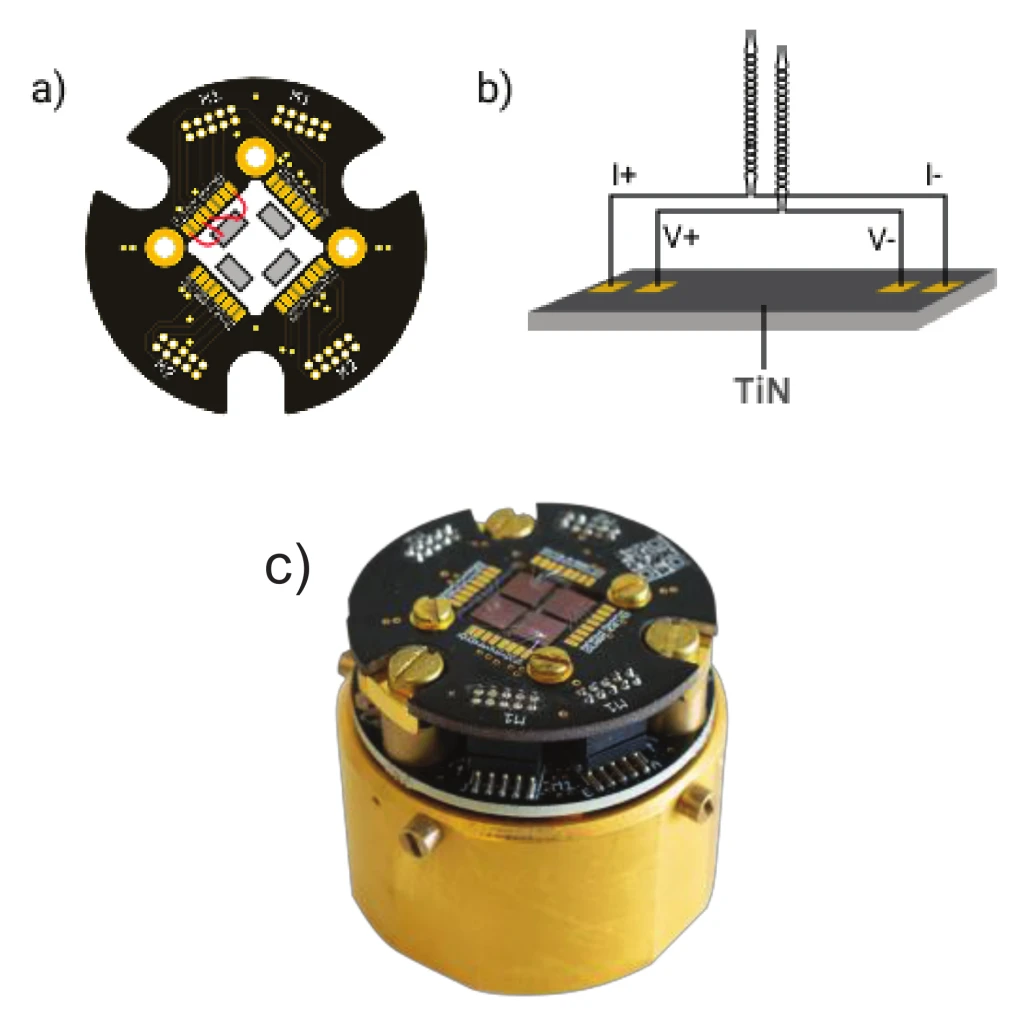
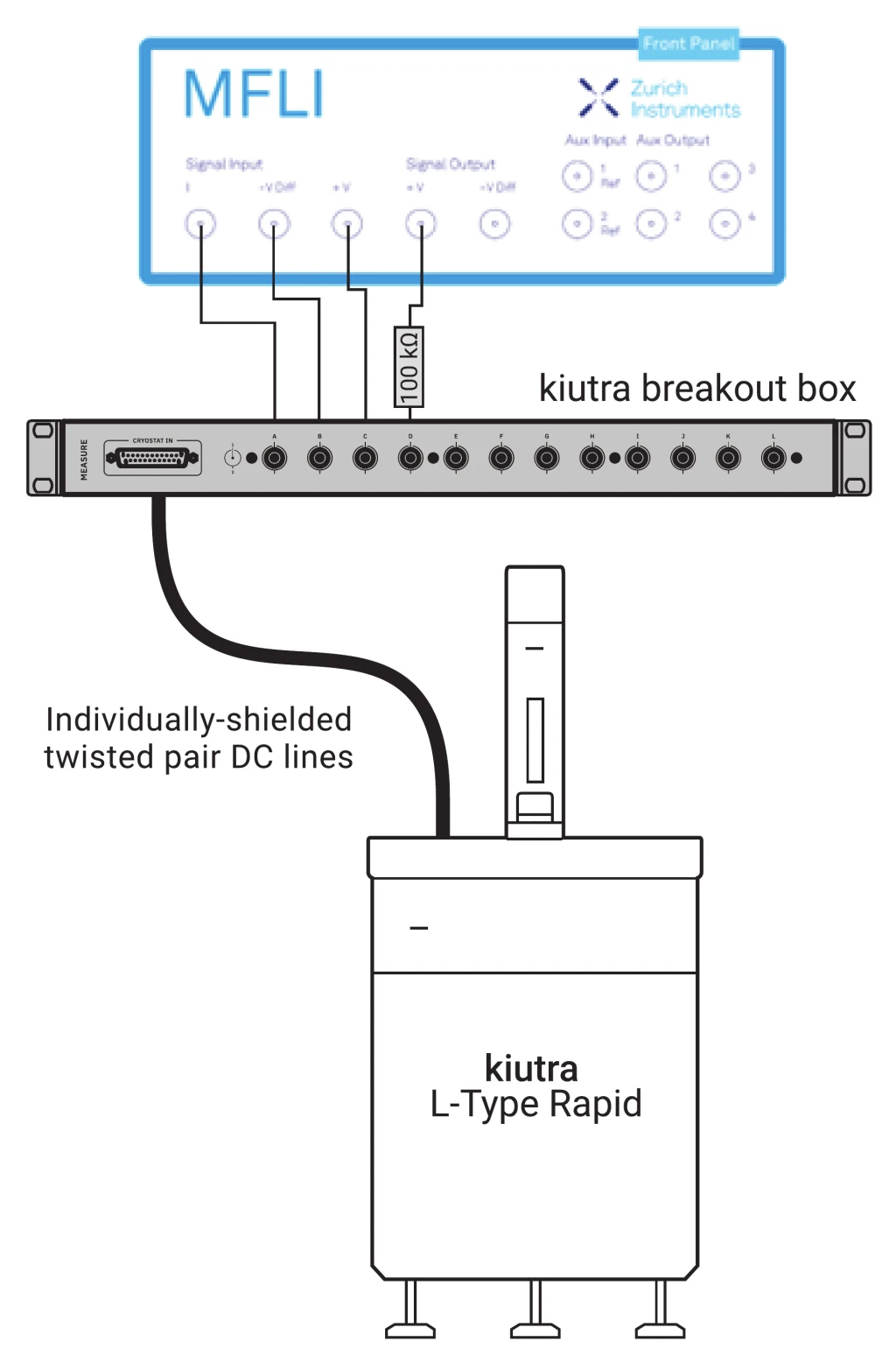
A bias resistor of 100 kΩ converts a 1 V output voltage of the MFLI to an excitation of 10 μA, which flows through the sample. To maximize the signal-to-noise ratio, we use a lock-in detection technique at a frequency of 133 Hz. We chose the modulation frequency after analyzing the noise environment of the setup using the Scope tool of the MFLI, which quickly checks the quality of the input signal and adjusts a suitable input range setting. A four-point resistance measurement can then be performed using the MFLI by simultaneously measuring the differential voltage and current with two distinct demodulators assigned to the same oscillator.
Experimental results
To characterize the sample resistance as a function of the temperature, we program a measurement of the voltage and return current while changing the temperature at the sample stage. For the latter, we use the integrated temperature control of the kiutra LTR cryostat with a ramp rate of 0.1 K/min. For the lock-in amplifier configuration, we chose a filter time constant of 500 ms and a filter order of 3. We save the measurement data with a sampling rate of 10 times higher than the inverse of filter time constant. Finally, we initiate the temperature ramp and resistivity measurements at the same time with a software trigger, which allows us to interpolate and map the temperature data to resistivity measurement.
Figure 3 shows the resistance of the sample as a function of temperature. We observe a distinct drop of the resistance at 5.2 K, at which point the finite resistance value (higher temperatures) changes to a zero-resistance state (lower temperature). Thanks to the high sampling rate achievable with the MFLI and the steady and smooth temperature ramping of the kiutra LTR, it is possible to resolve the very sharp edge of the superconducting transition to mK resolution (see plot inset). In addition, we observe no residual resistivity above the noise threshold, indicating a full superconducting transition of the sample.
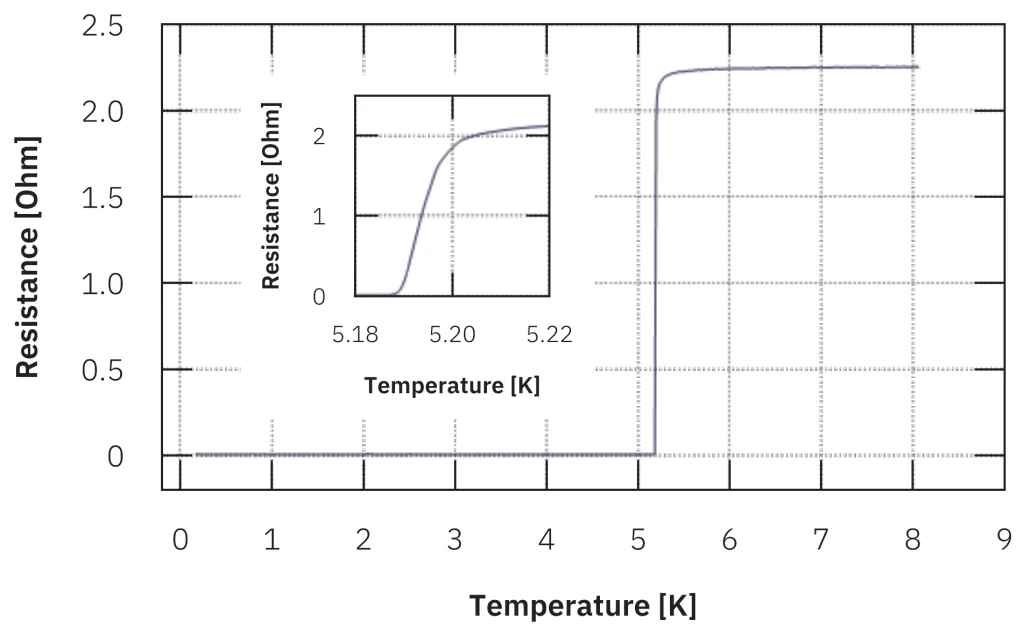
The Tc result we measure is consistent with expected values found in the literature, for instance, for a thin-film of stoichiometric TiN with final thickness 700 nm, deposited via DC sputtering onto a Silicon substrate1. It is well-established in the literature that the Tc of this and other similar quantum materials is highly dependent on fabrication variables like sputtering rate, chamber pressure during deposition, sample treatments like annealing or hydrofluoric acid-based cleaning to remove native oxides and, ultimately, the final thickness of the thin-film. For this reason, we highlight the importance of our fast characterization approach in speeding up fabrication feedback, enabling researchers to efficiently engineer the desired superconducting properties of their films.
Conclusions and outlook
We present a fast and efficient method for characterizing the critical temperature of a TiN thin-film using a kiutra L-Type Rapid fast turnaround cryostat and a Zurich Instruments MFLI lock-in amplifier. Our setup streamlines the study of low-temperature electrical properties of materials, helping to accelerate research in material science and quantum device fabrication.
In particular, the L-Type Rapid enables a full measurement cycle in less than five hours, significantly reducing the time required for low-temperature characterization. By automating key processes such as sample loading, cooldown, and temperature control, it minimizes manual effort and ensures consistent, repeatable results. This level of efficiency and automation makes the L-Type Rapid an ideal solution for integration into fabrication environments and shared research facilities, where fast turnaround and ease of use are essential.
Looking ahead, the ability to rapidly characterize superconducting materials will be increasingly valuable as quantum technologies advance. The kiutra L-Type Rapid cryostat and the Zurich Instruments MFLI lock-in amplifier prove to be a powerful and user friendly combination for precise, high-sensitivity electrical measurements at millikelvin temperatures. By simplifying access to advanced cryogenic and measurement techniques, this setup helps researchers and engineers push the boundaries of material science and device fabrication, ultimately accelerating innovation in superconducting electronics and quantum science and technology.
Acknowledgements
We would like to thank the Fraunhofer Institute for Electronic Microsystems and Solid-State Technologies (EMFT) for providing us with the superconducting samples used for the measurements presented here.
- Faley, M. I., Liu, Y., & Dunin-Borkowski, R. E. (2021). Titanium Nitride as a New Prospective Material for NanoSQUIDs and Superconducting Nanobridge Electronics. Nanomaterials 2021, 11, 466.
About Zurich Instruments
Zurich Instruments makes cutting-edge instrumentation for scientists and technologists in advanced laboratories. We have revolutionized instrumentation with fully digital lock-in amplifiers and the first commercial quantum computing control system. By combining excellent hardware, signal generation, and signal analysis in the frequency-domain and time-domain within single products, we help to reduce the complexity of laboratory setups and support innovative measurements in the DC to Gigahertz range.
Take this information with you.
Download PDF
Contact
Get in touch with our team
From first experiments to scaled-up quantum systems, our team can help you find the right cooling system for your work.
-
Customer support
-
Interested in joining kiutra?
-
Give us a call
-
Visit us
kiutra GmbH
Flößergasse 2
81369 Munich
Germany