



Application note
Multi-device electron temperature benchmarking using Coulomb Blockade Thermometers
We realize high-precision electron temperature measurements in a kiutra L-Type Rapid cryostat using Coulomb Blockade Thermometers (CBTs). By integrating Quantum Machines QSwitch and QDAC-II compact, we measure four on-chip CBTs in a single cooldown to a cryostat temperature of 40 mK, detecting electron temperatures of 47-50 mK. Thanks to the primary nature of CBTs, their stable and reproducible performance confirms a clean, well-controlled cryogenic and measurement environment. Our results demonstrate high-throughput, multi-device benchmarking, emphasizing both the robustness of the measurement setup and the reproducibility of the CBTs.
Keywords: Electron Temperature; Fast-fabrication feedback; Coulomb Blockade Thermometer; Quantum system optimization.
Products: kiutra L-Type Rapid; QSwitch; QDAC-II compact; QBoard-II.
Introduction
In cryogenic experiments, achieving millikelvin base temperatures does not automatically guarantee that electrons in devices are equally cold. At these low temperatures, electrons can remain hotter due to weak electron-phonon coupling and residual noise. Achieving the right electron temperature is crucial because it directly affects the behavior of quantum devices, single-electron circuits, and superconducting systems.
In single-electron devices, small temperature deviations smear out characteristic conductance features, while in superconducting circuits elevated electron temperatures increase quasiparticle populations, suppress the superconducting gap, and degrade qubit coherence. Without precise electron thermometry, it is difficult to distinguish intrinsic device performance from residual heating or environmental noise artifacts. Direct electron thermometry becomes relevant for reliable device characterization.
The electron temperature characterizes the thermal state of conduction electrons in devices and governs the relevant energy distribution for low-temperature transport measurements. In this application note, we measure it using CBTs paired with Quantum Machines electronics in a kiutra LType Rapid (LTR) cryostat, under realistic operating conditions. Using the QSwitch and QDAC-II compact, we measure four CBTs jointly fabricated by Aalto University & VTT. The samples are placed in a QBoard-II and cooled to a 40 mK cryostat temperature.
We present an automated workflow for high-throughput benchmarking of multiple devices while providing a sensitive probe of the cryogenic noise environment. Our approach enables electron temperature readouts of 47–50 mK, validating the performance of the cryostat system and measurement electronics and offering a practical framework for optimizing electron thermalization in cryogenic experiments.
Measurement plan
Electron temperature is probed by Coulomb Blockade Thermometry1. The CBTs we use in this application note consist of an array of 50 tunnel junctions in series. The array exhibits a bias dependent reduction in conductance due to Coulomb blockade, which suppresses tunneling until the applied voltage overcomes the charging energy e2/2C. In the limit of weak Coulomb blockade, the suppression is governed by the charging energy and the temperature. Since both parameters can be individually extracted from the shape of the conductance dip, a measurement of the electron temperature without any external calibration parameters or reference temperature is possible.
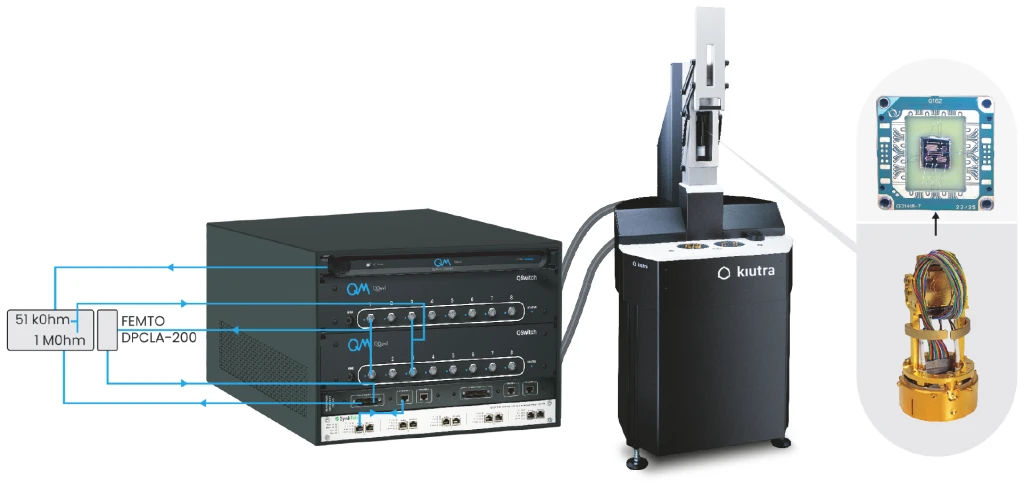
The thermometers are bond-wired in a two-point probe configuration onto a QBoard-II daughterboard and mounted on a Qboard-II motherboard to be measured under controlled cryogenic conditions. We connect the QBoard-II with the CBTs to a kiutra Puck 55 to load it into an LTR. After loading it, we set the LTR sample stage temperature at 40 mK. Figure 1 shows a schematic picture of the setup used in this note.
The conductance of the CBTs is measured using a combination of AC and external DC voltage bias.
These measurements are performed with a Synktek MCL1-540 lock-in amplifier with the external bias provided by a QDAC-II. The lock-in signal and bias are combined and scaled appropriately using a custom voltage divider. Return current is amplified by a FEMTO DLPCA-200 transimpedance amplifier before being detected by the lock-in input channel. Multi-device detection is enabled by two QSwitches, allowing all devices to be scanned using only two terminals. In this experiment, four CBTs in two-port configurations were measured. Nonetheless, a total of 47 devices could be measured in one single measurement run by sharing a common pin, using the 48 DC lines of the cryostat and the QSwitches. Once connected to the top of the cryostat DC connectors, the QSwitch automatically switches between devices via software control, streamlining high-throughput measurements.
The measurement process is fully automated. A script controls both the electronic instruments as well as the cryostat temperature setpoint. Once the cryostat reaches the target temperature, the measurement sequence is initiated. For each device, the script sets the desired DC and AC bias, measures the conductance, saves the data, and then automatically switches to the next device, repeating the process for all devices of interest.
The results in this application note were obtained in temperature steps of 10 mK, starting at 40 mK and stopping at 200 mK. For each temperature step, we measured for 15 min scanning all devices in one chip before changing the temperature setpoint. This allows for proper integration time in the data collected using the lock-in amplifier.
We extract the electron temperature in post processing by means of least squares fit to the conductance dip, using a fitting model based on a numeric solution to the master equation governing the dynamics2. We want to emphasize that the extraction of the temperature can be directly integrated with the data collection, enabling a direct use of the CBTs as primary thermometer. It was omitted in this case, since the goal of our measurements was to provide fast data collection for device screening.
Experiment results
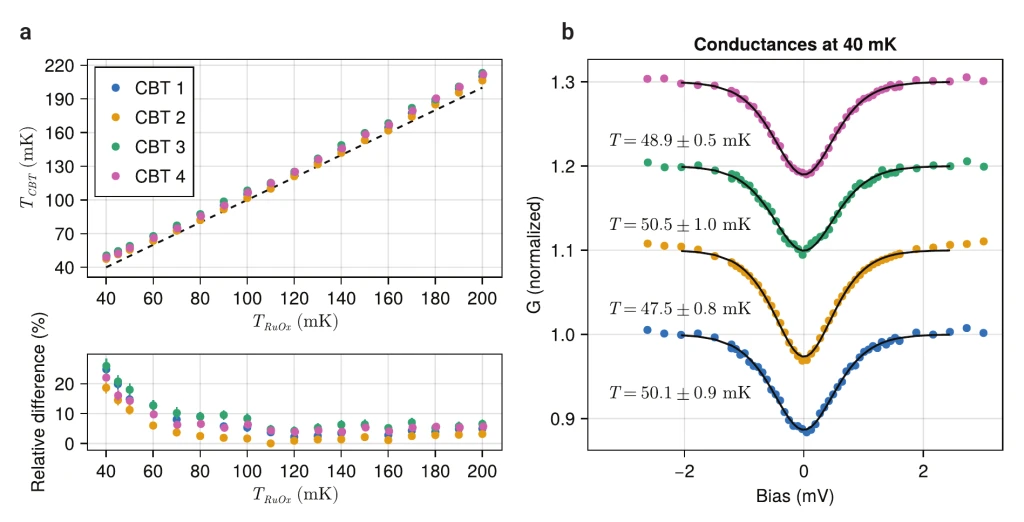
Figure 2a (top), shows the extracted electron temperature of all CBT devices in a temperature sweep and Figure 2b, the electron temperature extracted from four CBT devices measured in a single measurement run at a cryostat temperature setpoint of 40 mK. An offset to normalized conductance is added for visualization.
At the lowest temperature, the devices exhibit electron temperatures between 47–50 mK, slightly above the cryostat setpoint. The small spread between devices, shown in Figure 2a (bottom), demonstrates the reliability of the CBTs and indicates that the cryostat temperature is stable and electrons on the Qboard-II connected to the kiutra Puck 55 are well thermalized. Further, the reproducibility across devices provides a straightforward estimate of device-to-device uncertainty in the Coulomb blockade thermometry. Overall, these results demonstrate that our experimental approach enables stable and reliable determination of electron temperatures in the sub-100 mK regime.
Accurate measurement of electron temperatures across multiple CBT devices provides a valuable tool for optimizing cryogenic environments. By monitoring temperatures under different wiring configurations, shielding, or sample mounting strategies, the presented setup can guide improvements in thermalization and reduce residual heating at the sample. These insights can inform the design and validation of low-temperature systems, helping achieve electron temperatures close to the cryostat base in sensitive quantum experiment.
Conclusions
We achieve reliable electron temperature measurements in the sub-100 mK range using Coulomb Blockade Thermometers mounted on a Qboard-II sample holder inside a kiutra L-Type Rapid cryostat. Multiple devices are measured efficiently within a single measurement run, with electron temperatures closely tracking the 40 mK cryostat temperature and exhibiting only a small device-to-device spread. The consistent and low temperature readings indicate a well-controlled, low-noise cryogenic environment and a high-quality measurement setup. Our results position CBTs as a robust and precise solution for electron thermometry, delivering reproducible performance across multiple devices and dependable monitoring of cryogenic environments.
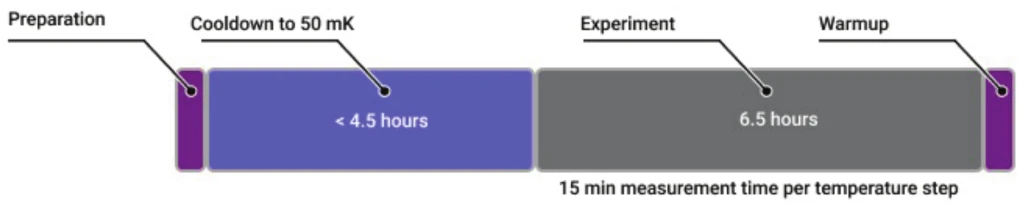
Beyond individual measurements, we demonstrate a high-throughput workflow enabled by rapid cryostat turnaround and fully automated, software-controlled device multiplexing using Quantum Machines QSwitch and QDAC-II compact. This approach allows many devices to be measured with minimal wiring. For an L-Type Rapid with 48 DC lines, it scales to up to 47 two-point-contact devices per measurement run, remaining extensible to multiple consecutive runs. The resulting short end-to-end turnaround times, summarized in Figure 3, enable fast device screening and improved fabrication control through systematic comparison of large device sets under identical cryogenic conditions. Together, the kiutra L-Type Rapid cryostat and Quantum Machines electronics provide a turnkey, scalable platform for accelerating device development in advanced quantum experiments.
Acknowledgements
About Cryotherm CBT R2B
Cryotherm CBT R2B, the joint Aalto University & VTT research to business project, is currently funded by Business Finland, evaluating the commercial potential of Coulomb blockade thermometers (CBTs). Grown out of Aalto university’s low temperature lab, we are developing a primary, magnetic field immune electron thermometry solution for use in the broad cryogenics segment. To learn more, visit https://www.aalto.fi/en/innovation-portfolio/cryotherm.
References
- J. P. Pekola, K. P. Hirvi, J. P. Kauppinen, and M. A. Paalanen, “Thermometry by Arrays of Tunnel Junctions,” Physical Review Letters, vol. 73, no. 21, pp. 2903–2906, Nov. 1994, doi: 10.1103/physrevlett.73.2903.
- K. Hirvi, “One dimensional arrays of small normal metal tunnel junctions as thermometers and single charge pumps,” Doctoral thesis, Jyväskylän yliopisto, 1997. [Online]. Available: https://jyx.jyu.fi/jyx/Record/jyx_123456789_85675?sequence=1
About Quantum Machines
Quantum Machines (QM) is driving the future of quantum computing through Hybrid Control, seamlessly integrating quantum and classical computing. Conventional controllers struggle with disjointed operations, creating friction that limits scalability. The Pulse Processing Unit (PPU), at the core of QM’s innovation, is a special processor for quantum control, designed to eliminate this barrier by bringing classical computing closer to qubits, reducing latency and enabling realtime execution of quantum error correction, and other advanced algorithms. The hybrid development platform further streamlines development, empowering quantum computer builders to create efficient quantum-classical programs. OPX1000, QM’s flagship controller, embodies this hybrid approach. It is a modular, high-density control platform with a cutting-edge quantum-led analog front end. OPX1000 is tailored for large-scale quantum computers, offering unparalleled performance, scalability, and ready HPC integration, including an ultra-fast interface to GPU/CPU accelerators for boosting quantum control. With hundreds of deployments worldwide, Quantum Machines’ solutions are trusted by quantum computer builders, research labs, and HPC centers. For more information, visit quantum-machines.co.
Take this information with you.
Download PDF
Contact
Get in touch with our team
From first experiments to scaled-up quantum systems, our team can help you find the right cooling system for your work.