
Application note
High-Precision Heat Capacity Measurement Platform for Quantum Materials
Heat capacity measurements serve as a fundamental tool to understand the physical properties of quantum materials. We present a heat capacity setup compatible with the L-Type Rapid cryostat, designed for fast and precise characterization from millikelvin to room temperature and in applied magnetic fields. The system features fully automated sample loading and cooling, efficient thermalization, and precise temperature control, ensuring high-resolution data acquisition.
Keywords: Heat capacity, quantum materials, thermodynamic properties, phase transitions.
Products: kiutra L-Type Rapid.
Introduction
Heat capacity measurements are indispensable in quantum materials research as they provide critical insights into the underlying thermodynamic and microscopic properties of a material. These measurements are essential in understanding quantum phenomena, testing theoretical models, and uncovering emergent behaviors in novel materials, making them a cornerstone in the study of condensed matter physics and materials science.
At cryogenic temperatures, where heat capacities become exceedingly low, highly sensitive calorimetric techniques and precise thermal control are required to detect minute temperature changes and ensure accurate yet fast experiments. Here, we showcase the advantages of a sophisticated heat capacity setup in the kiutra L-Type Rapid. The ability to perform heat capacity measurements in a fast characterization cryostat opens new avenues for efficient and comprehensive material characterization.
Heat capacity setup
The L-Type Rapid features a puck-based system for easy sample preparation and loading. The heat capacity setup is prepared and tested outside the cryostat using the kiutra Sample Puck Station. The entire experiment is then transferred into the cryostat using an automated sample loader and automatically cooled down to the desired temperature. An optional sample magnet enables measurements under applied field. The entire process is fully controlled via modern instrument control software for intuitive operation and real-time monitoring.
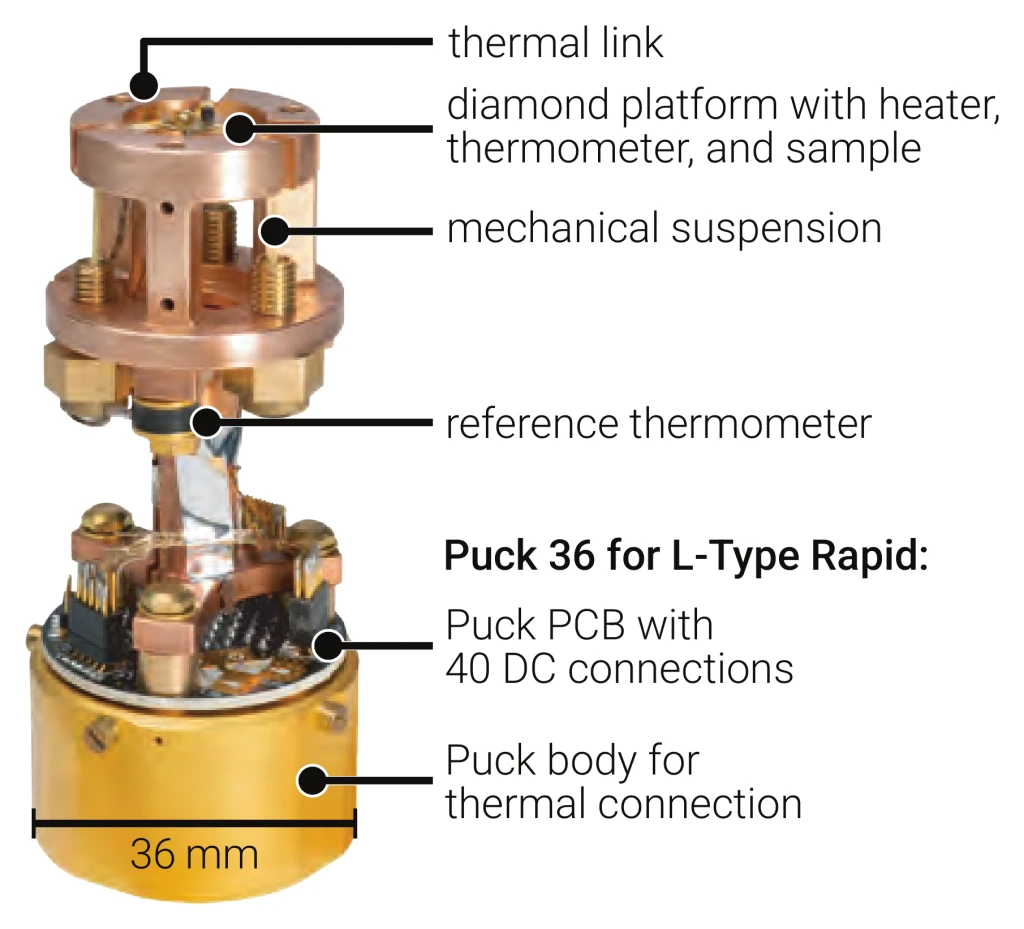
Measurements of heat capacity at low temperatures require careful experimental design. Fig. 1 shows the heat capacity setup mounted on an L-Type Rapid Puck 36. The copper body of the setup acts as the thermal bath for the experimental platform which is coupled to the bath through an interchangeable link and suspended via Kevlar threads. In combination with the short turnaround time of the kiutra L-Type Rapid this interchangeable link allows a fine control of the time constant of the experiment, which can vary widely depending on sample mass and material studied. Adjusting this link allows to find an optimum for resolution and speed of measurements. The thermometers and heater of the setup are connected to the DC connections on the puck PCB and will interface with the cryostat wiring upon loading. The contribution of the heat capacity of the platform and all its components—the addenda—is determined and subtracted from the data. In addition, the coupling between the platform and the sample is very well controlled to reduce the τ2-effects.
Experimental data
To showcase heat capacity measurements in the L-Type Rapid we have studied the heat capacity of Indium and compared to data from literature1, as shown in Fig. 2a). The heat capacity was obtained using the thermal relaxation method. Thereby, the sample is heated using a constant heat input resulting in an exponential increase in temperature. Turning off the heating gives an exponential decay back to the starting temperature. Fig. 2b) and c) show the temperature during one characteristic heat pulse using this method. The heat capacity of the sample can then be extracted by fitting an exponential to the heating and cooling phases2, respectively, called the “exponential method” in Fig. 2b). The “setup response method”3, cf. Fig. 2c), uses an algorithm presented by Hwang et al. that takes the addenda and τ2-effects into account and allows for a larger variety of sample sizes and time constants in adiabatic and non-adiabatic conditions. Note that for the shown heat pulse τ2-effects and addenda are intrinsically small and both methods yield good results.
![Three-panel data plot. Panel a) plots heat capacity C in mJ/K against temperature T from 1 to 5 K for Indium 4N (99.99%); the setup response fit and the exponential fit lie on top of each other, the Bryant & Keesom Ref. [1] data follows them up to about 2.5 K and runs above them at higher temperature, and the addenda of the setup forms a lower black curve. Panels b) and c) plot the temperature rise Delta T in mK against time from -50 to 150 s at T = 2.88 K for one heat pulse; b) shows the measured points with a single setup response fit, c) shows the same points with separate exponential fits for heating and cooling.](https://kiutra.com/media/pages/resources/heat-capacity-measurement-platform-for-quantum-materials/ca17c66304-1789748676/heat-capacity-measurement-platform-for-quantum-materials-fig2-1024x.webp)
Conclusion
Accurate heat capacity measurements at millikelvin temperatures and under applied magnetic fields are essential for studying quantum materials. The L-Type Rapid facilitates these measurements with fully automated sample loading and cooling, efficient thermalization, precise temperature control, and minimized heat losses. These features enable reliable, high-resolution data acquisition, supporting investigations of quantum phase transitions, electronic correlations, and other fundamental properties.
- CA Bryant/PH Keesom, in: Phys. Rev. 123.2 (1961).
- R Bachmann et al., in: Rev. Sci. Instrum. 43.2 (1972).
- JS Hwang et al., in: Rev. Sci. Instrum. 68.1 (1997).
Take this information with you.
Download PDF
Contact
Get in touch with our team
From first experiments to scaled-up quantum systems, our team can help you find the right cooling system for your work.
-
Customer support
-
Interested in joining kiutra?
-
Give us a call
-
Visit us
kiutra GmbH
Flößergasse 2
81369 Munich
Germany