
Application showcase
L-Type Rapid for long-term T1 benchmarking of superconducting qubits
Understanding the relaxation time T1 of a qubit is a key indicator for it's overall performance in quantum computing applications. The ability to capture T1 statistics over extended periods of time allows researchers to assess the impact of two-level system (TLS) fluctuations and other environmental factors on qubit stability.
In this showcase, we demonstrate how extended T1 measurements can be conducted using the newest configuration of our L-Type Rapid fast characterization cryostat offering 50 mK base temperature and 100 mK continuous operation. Using a Zurich Instruments SHFQC+, we characterized the T1 of a superconducting transmon qubit supplied by Peak Quantum over a 24-hour period at 100 mK. Our results, shown in Fig.1, demonstrate an average T1 of 97 µs.
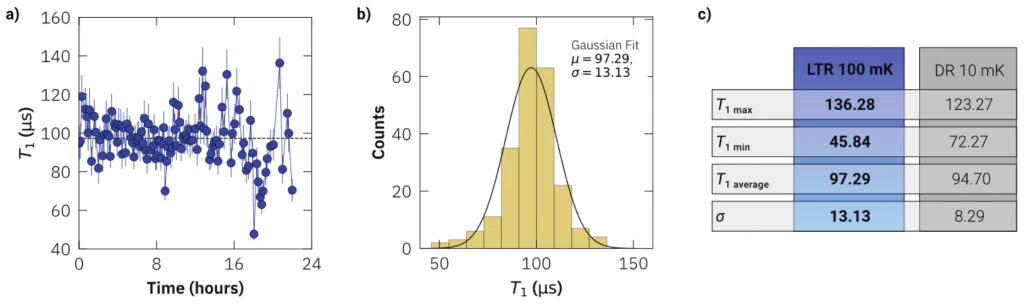
To benchmark the performance of the L-Type Rapid, we compared our results with the pre-characterization data provided by Peak Quantum, acquired for the same qubit in a dilution refrigerator at 10 mK. Our analysis shows that T1 measurements at 100 mK in the L-Type Rapid are matching the results obtained at 10 mK in a dilution refrigerator both in quality and consistency. This demonstrates how the L-Type Rapid enables high-fidelity qubit characterization even at 100 mK, significantly enhancing experimental efficiency and throughput.
Acknowledgements
We want to thank Peak Quantum for providing us with the qubit chip and for performing the reference measurement in a dilution refrigerator and Zurich Instruments, for providing us with the SHFQC+, used for this application showcase.
To learn more, visit www.kiutra.com
Take this information with you.
Download PDF
Contact
Get in touch with our team
From first experiments to scaled-up quantum systems, our team can help you find the right cooling system for your work.
-
Customer support
-
Interested in joining kiutra?
-
Give us a call
-
Visit us
kiutra GmbH
Flößergasse 2
81369 Munich
Germany