
CRYOGENIC SERVICES / SENSOR CALIBRATIONS
Calibration measurements as a service

CRYOGENIC SERVICES / SENSOR CALIBRATIONS
Calibration measurements as a service
Accurate temperature measurement is essential for low-temperature experiments and therefore requires well-calibrated sensors. The relationship between a sensor’s electrical response and the actual temperature is measured using a certified reference thermometer. The resulting calibration curve allows precise conversion of the sensor signal into temperature.
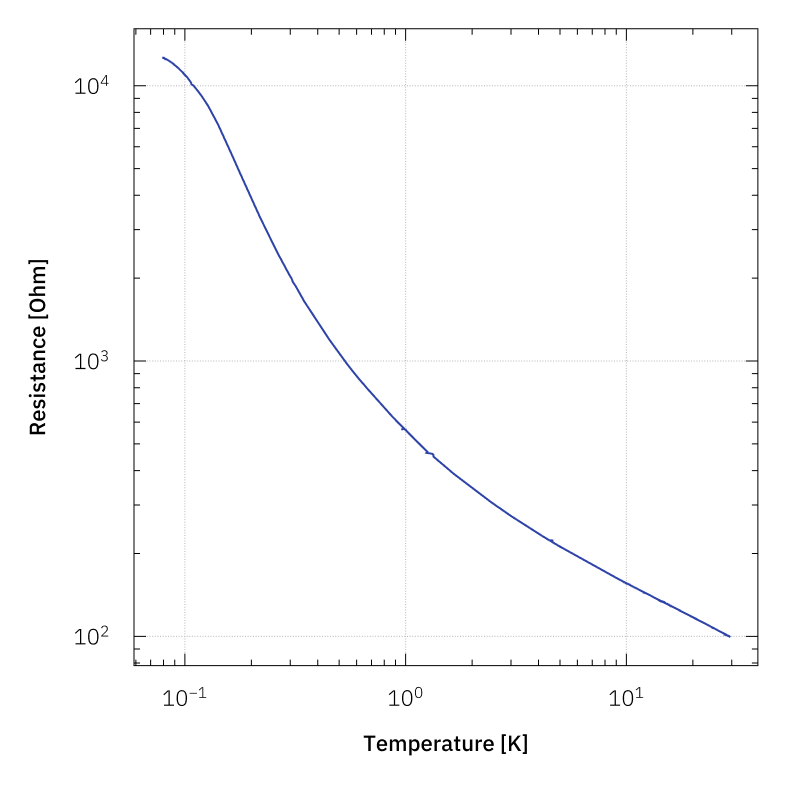
Log–log resistance–temperature (R–T) calibration curve of a Lakeshore Cernox® temperature sensor.
How does a standard calibration measurement work?
To obtain an R–T calibration curve, the sample is cooled to the lowest target temperature, followed by discrete temperature steps. At each temperature setpoint, a waiting time is applied to ensure proper thermalization before the electrical response of the sensor is recorded. The measurement is performed using an AC lock-in technique. The lock-in amplifier enables precise readout even at very low signal levels by referencing all measured signals to a fixed excitation frequency. This ensures that only voltage responses at the excitation frequency contribute to the measurement, significantly improving the signal-to-noise ratio.
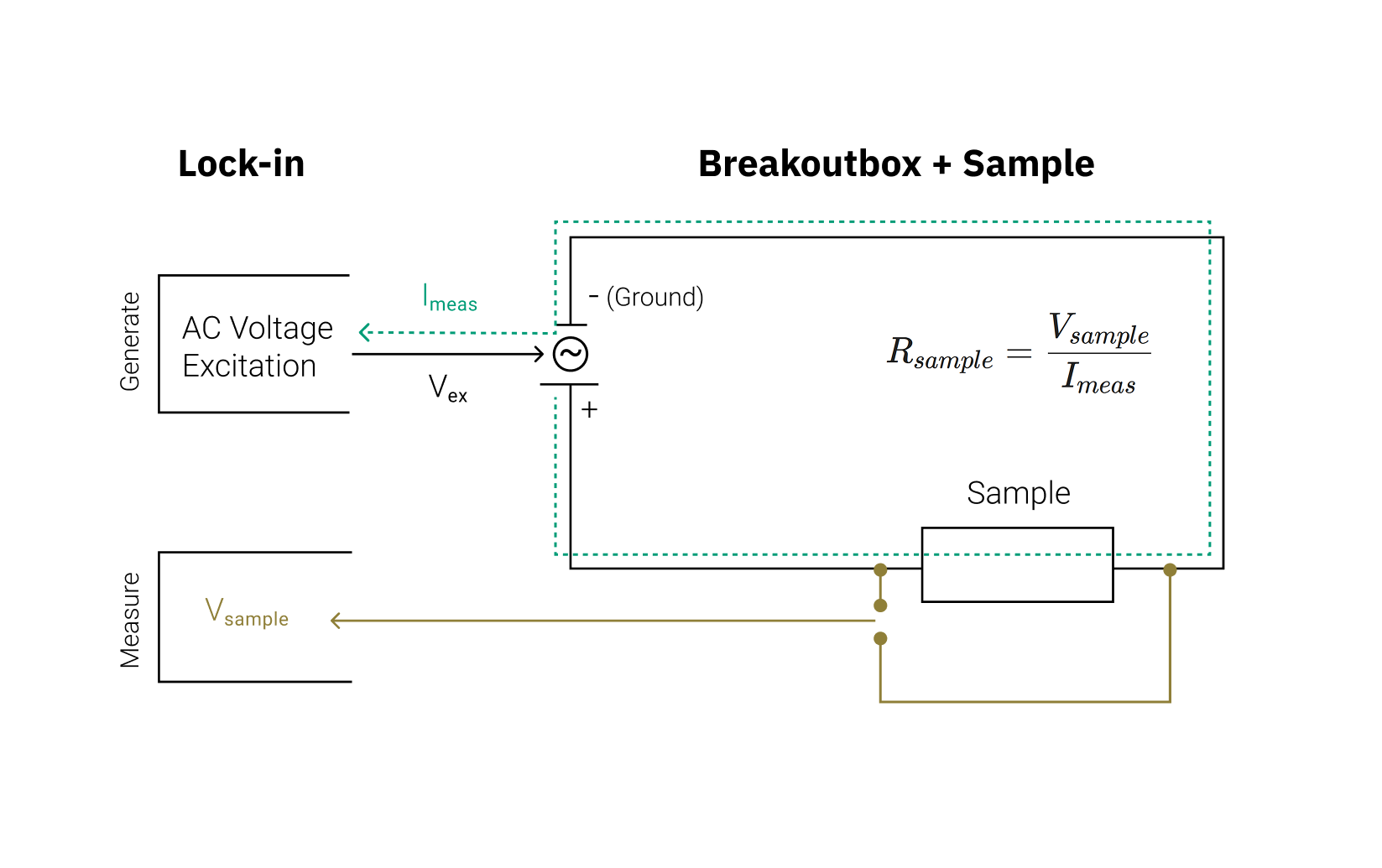
The sample is excited with a voltage provided by the lock-in amplifier. By measuring both the return current and the voltage drop across the sample, the resistance can be determined. The voltage drop is measured using two separate voltage leads which are connected close to, or directly to the sample. This eliminates any contribution from wires or contact resistances, ensuring that the measured voltage reflects only the sample itself. For multiple measurement channels, the excitation can be configured individually for each measurement channel. The return current is measured for all channels individually.
Click image to enlarge
The sensor is excited with a defined voltage. The voltage drop across the sensor is measured using a four-point configuration. By additionally measuring the resulting current, the resistance is determined.
Sample carrier and breakout
Kiutra offers a range of sample carriers for mounting and contacting samples. Alternatively, kiutra can evaluate the compatibility of customer-provided sample holders or support in designing custom holders for specific applications.
kiutra PAD32
The PAD32 is a standard kiutra sample carrier that features 32 gold-plated bonding pads, optimized for four-point electrical measurements. A 10 x 10 mm cutout offers space for up to eight devices, which can be attached to a gold-plated, high-purity oxygen-free copper (OFHC) plate. After the measurement, the PAD32 is returned to the customer for further use.
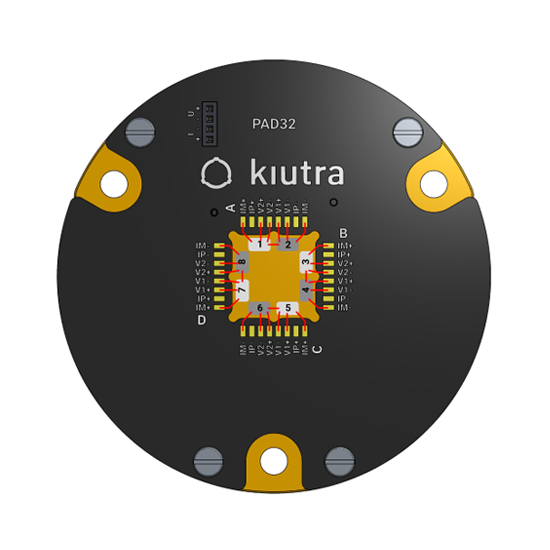
a) Drawing of a kiutra PAD32 with eight samples bonded to the pads. The pad layout is optimized for four-point measurements by assigning dedicated twisted pairs for current (I±) and voltage (V±), enabling short bond lengths and avoiding wire crossings.
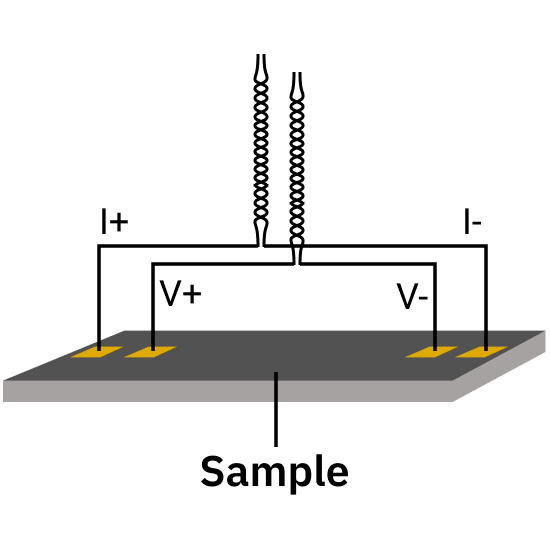
b) Schematics of the four-point measurement technique.
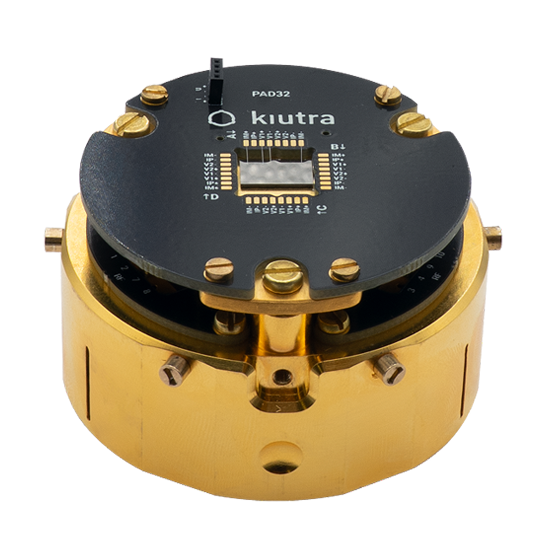
c) A kiutra PAD32 sample carrier with one device mounted on a kiutra Puck 55.
kiutra PAD48
The PAD48 is a standard kiutra sample carrier that featuring 48 gold-plated bonding pads. In contrast to the PAD32, the PAD48 uses a conventional pad assignment with twisted pairs side by side. This offers more flexibility, but bonds might be crossed. While four-point measurements are equally supported, wire bonding may involve longer bonds and crossings depending on the device layout. A 10 x 10 mm cutout offers space for up to twelve devices, which can be attached to a gold-plated, high-purity oxygen-free copper (OFHC) plate. After the measurement, the PAD48 is returned to the customer for further use.
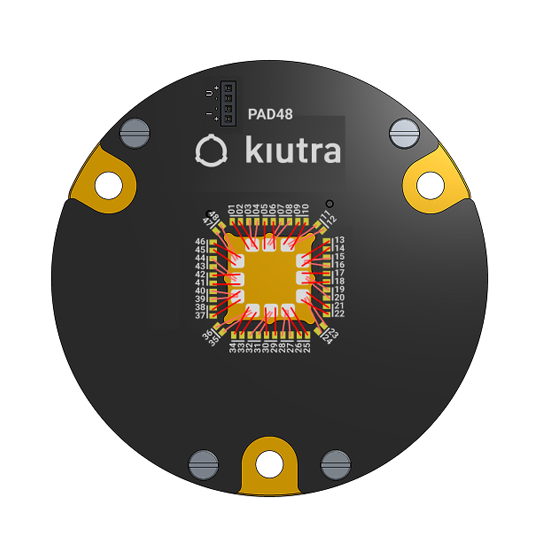
a) Drawing of a kiutra PAD48 with twelve samples bonded to the pads. Due to the side-by-side assignment of twisted pairs, wire bonds may cross and therefore require careful routing to avoid contact between individual bonds.
b) Schematics of the four-point measurement technique.
c) A kiutra PAD32 sample carrier with one device mounted on a kiutra Puck 55.
kiutra Needle Card
As an alternative to wire bonding, kiutra provides a needle card (probe card) solution for contacting samples, enabling non-destructive testing. The sample must be fabricated in a way that its contact pads align precisely with predefined XY positions of the probe card. kiutra offers a small range of probe card layouts for this purpose. Alternatively, kiutra offers to build custom probe cards for customer specific layouts. Electrical connections are established via Tungsten-Rhenium needles with flat 60µm tips which press against the sample pads, enabling a stable connection without bonding.
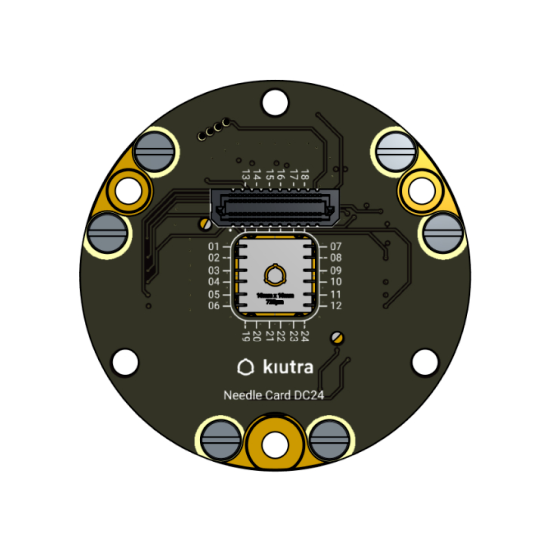
a) Drawing of the needle card
b) Schematics of the four-point measurement technique.
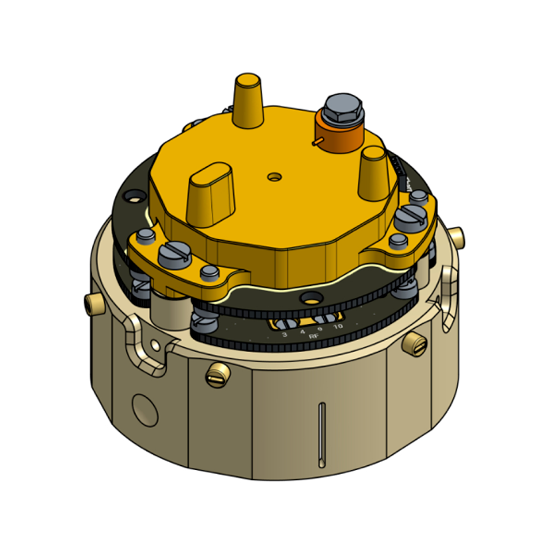
c) Needle card mounted on a kiutra Puck 55.
Cryostat interface
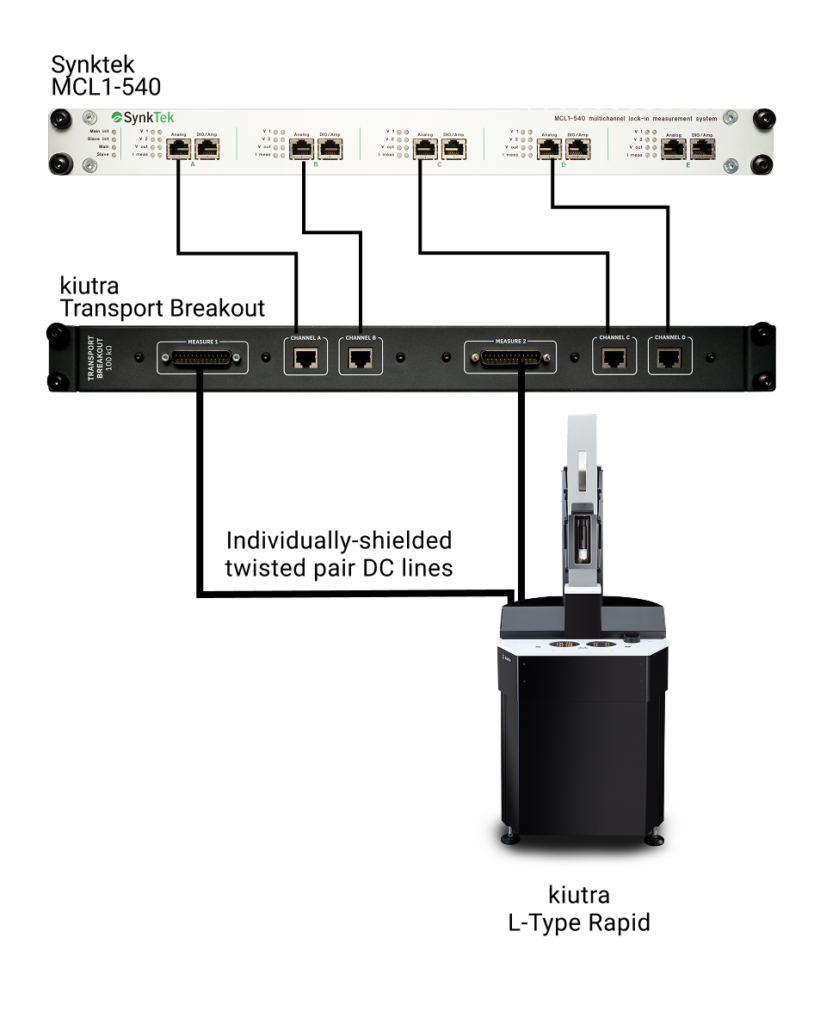
Once prepared, the sample carrier is mounted onto a puck, which seamlessly connects with the on-puck DC connectors. When loading the puck into an L-Type Rapid cryostat, the DC lines from the puck automatically mate with the internal twisted-pair DC wiring of the cryostat. At the top plate, the DC lines are divided into two D-Sub 25 connectors. They are connected via two 24-pin, twisted-pair, double-shielded measurement cables to a dedicated kiutra Transport Breakout Box, which allows mapping the lock-in channels to the cryostat’s internal wiring.
Click image to enlarge.
Measurement setup consisting of a Synktek MCL1-540 lock-in amplifier, a dedicated kiutra Transport Breakout Box, and a kiutra L-Type Rapid cryostat.
Standard measurement protocol
1. The kiutra sample puck with the sample carrier and the mounted, wire-bonded device is loaded into the cryostat and cooled down to bath temperature (~ 3K).
2. The puck is further cooled down to the lowest target temperature (50mK or 100 mK) and stabilized.
3. At the stabilized temperature setpoint, the electrical response of the device is measured using a lock-in amplifier. The excitation and the resulting voltage response are recorded continuously. If multiple samples are placed on the sample carrier, the parameters are recorded simultaneously using multiple channels of the lock-in amplifier.
4. The temperature is set to the next target temperature, stabilized, and step 3 is repeated.
5. Once the me measurement is concluded, the sample puck is unloaded from the cryostat.
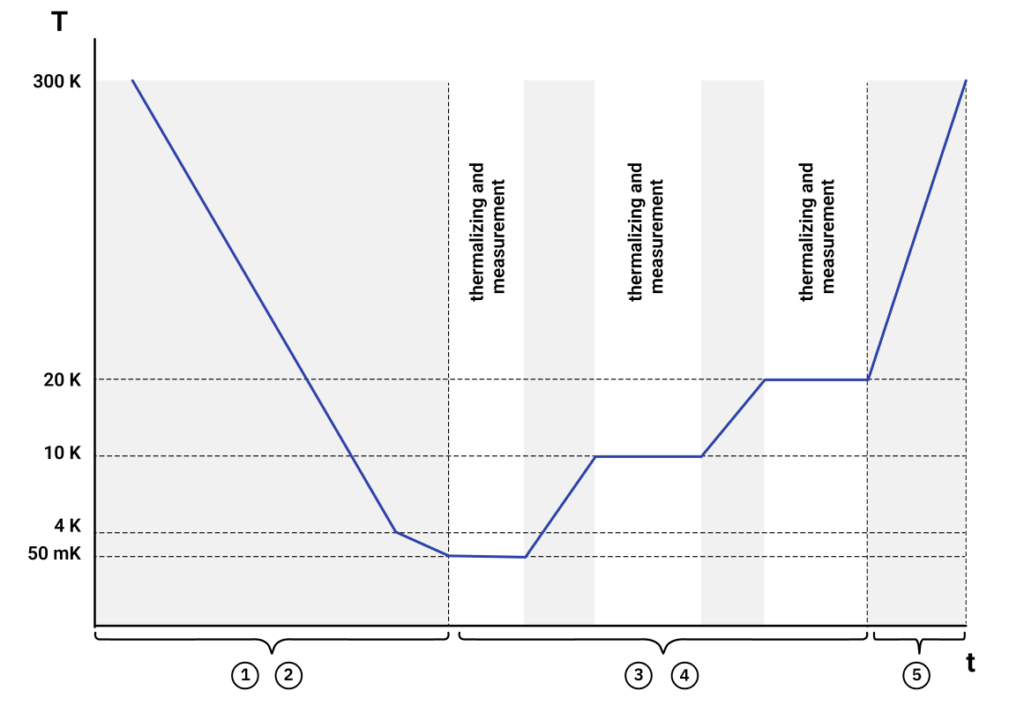
The curve shows the initial cooldown, waiting periods for thermalization, discrete temperature steps at 50 mK, 10 K, and 20 K (example setpoints) during which the measurement data are recorded, and the final removal of the puck.
Parameters:
* Value has to be provided by the customer prior to the measurement and must be within the specified range.
Can’t find what you need?
We support custom measurement requests for setups outside our standard protocol. Please get in touch for a quote. This will include a one-time setup fee. If you run the same measurement again later, we will reuse the protocol at no extra cost.
Email us at: info@kiutra.com.