
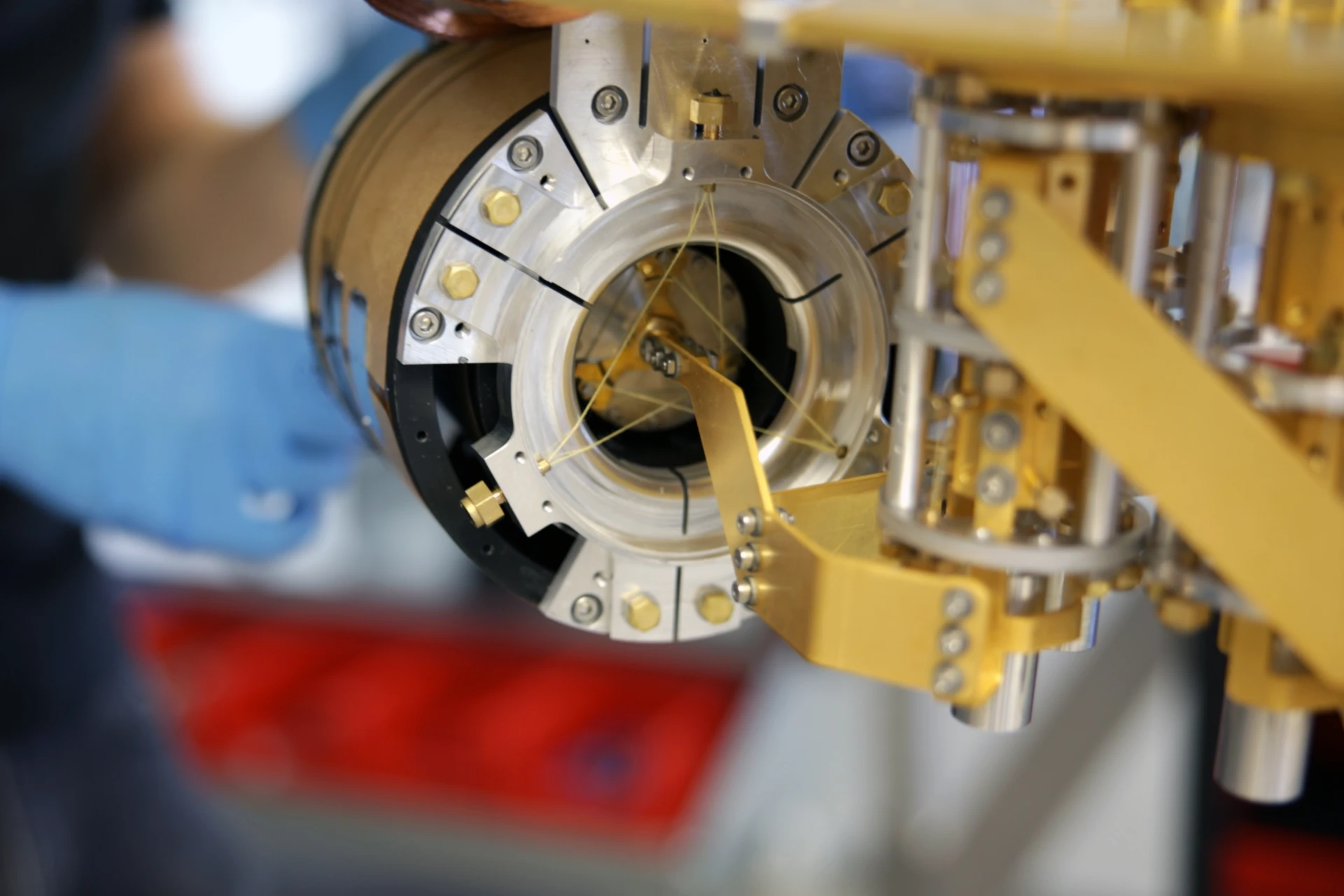
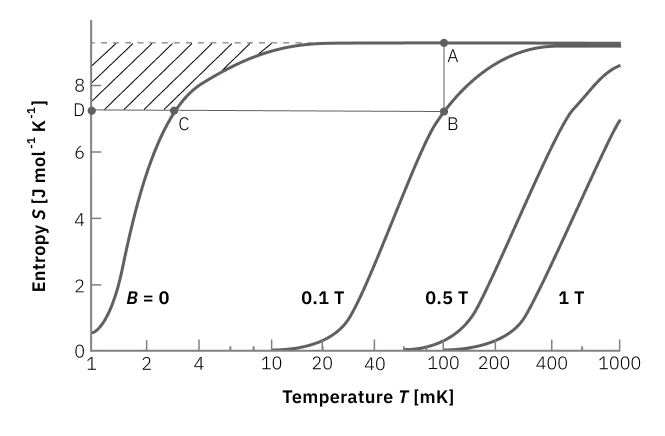
At the start of the ADR process, the heat switch connecting the ADR to the pre-cooling unit is closed, and both the cooling medium and the attached sample stage are cooled to the cryocooler base temperature of about 4 K.
While the heat switch is still closed, the cooling medium is magnetized by driving a current into the superconducting coil. The heat of magnetization is released and dissipated in the main thermal bath provided by the cryocooler.
Once the maximum magnetic field is reached, the cooling medium returns to its base temperature. The entropy of the system is now essentially determined by the magnetic contribution of the spin sub-system of the cooling medium.
The heat switch is then opened to break the thermal connection between the pre-cooling unit and the cooling medium. Reducing the magnetic field adiabatically lowers the temperature of the cooling medium, cooling the attached sample stage.
Usually the medium is not completely demagnetized. Instead, the magnetic field is tuned to settle at a target temperature, and the remaining field compensates for heat leaks from radiation, the support structure, and wiring, as well as heat generated by the user setup. By further reducing the field, the sample temperature can be stabilized with high precision for a limited period – the hold time – typically several hours.
Once the magnetic field reaches zero, the ADR process can be repeated. Regenerating the cooling medium – re-magnetizing and relaxing it – usually takes 1–2 hours, resulting in typical duty cycles of 70 to 95%.
How continuous adiabatic demagnetization refrigeration (cADR) works
To provide continuous cooling without cryogens, consider a system with two ADR units. As in the conventional one-shot ADR configuration, the first unit connects to the main thermal bath via a heat switch. This time, a second ADR unit is added: connected at one end to the first unit through another heat switch, and at the other end to the sample stage.
Besides this serial two-stage configuration, many cADR layouts with multiple ADR units are possible, including serial and parallel configurations and combinations of the two. The optimal configuration depends on the user’s demands and the specific payload.
Both ADR units are fully magnetized and connected through their respective heat switches, so the cooling media and sample stage start at the temperature provided by the cryocooler.
Unit 2 is decoupled from unit 1 and demagnetized, cooling the sample stage to the target temperature.
Unit 1 is disconnected from the bath and demagnetized too, stabilizing a temperature well below the setpoint of unit 2. The heat switch between the two units is then closed, and unit 2 can be regenerated while the sample-stage temperature is kept constant.
After unit 1 is depleted, the connection between the units is opened again and unit 1 is regenerated at the cryocooler temperature.
This procedure can be repeated indefinitely to provide continuous cooling at the sample stage.
L-Type Rapid
The L-Type Rapid offers easy access to the kelvin and sub-kelvin range and delivers the fastest testing and characterization on the market, combining high sample throughput with ease of use.
X-Type
The X-Type is a modular, helium-3-free cooling architecture for kelvin and sub-kelvin temperatures, designed specifically for scalable quantum systems.
T-Type Optical
The T-Type is an optical kelvin temperature cryostat optimized for trapped-ion chips.
Key terms
Heat switch
A heat switch is a tunable thermal link. Heat switches are widely used in cryogenics and are a key component for every magnetic refrigerator. In a magnetic refrigerator, a heat switch is used to decouple the ADR cooling medium from its pre-cooling stage during the demagnetization cooling. The heat switch is closed to conduct the heat of magnetization, which is generated during the regeneration process, into the pre-cooling stage. There are several types of heat switches, each with different advantages and disadvantages. The most common types are mechanical switches, gas-activated heat switches and superconducting heat switches. Another distinction is between active and passive heat switches. With active heat switches, the switching process can be controlled by the operator. With passive heat switches, the switching process always happens at a certain pre-defined temperature.
Hold time
With a ‘one-shot’ ADR cryostat, the cooling medium can provide cooling only for a limited amount of time, the ‘hold time’, which is determined by the cooling capacity of the medium. After the cooling medium is magnetized and the heat of magnetization has been dissipated in the pre-cooling stage, the heat switch is opened, and the cooling medium is partially demagnetized. During demagnetization of the cooling medium its temperature drops. Once the target temperature has been reached, demagnetization of the cooling medium continues at a smaller field ramp rate, which is set to compensate for thermal leaks through the support structure, thermal radiation, or customer setups. The total time available at the target temperature is the ‘hold time’. It ends once the magnetic field has been reduced to zero, i.e., when cooling medium is fully demagnetized, and the cooling process terminates. The hold time will vary as a function of temperature, so typically when the system is operated at the lowest temperature, the system may still be operated at higher temperatures by re-magnetizing the cooling medium. A major benefit of magnetic temperature control is that temperatures can be stabilized with high precision, as no valves, capillaries, or heaters are involved.
One-shot
With a ‘one-shot’ ADR cryostat, the cooling medium provides cooling for a limited amount of time, known as the ‘hold time,’ which is determined by the cooling capacity of the medium. After the cooling medium is magnetized and the heat from magnetization has dissipated in the pre-cooling stage, the heat switch is opened, and the cooling medium is partially demagnetized. During demagnetization, the temperature of the cooling medium drops. Once the target temperature is reached, demagnetization continues at a slower field ramp rate, which is set to compensate for thermal leaks through the support structure, thermal radiation, or customer setups. The total time available at the target temperature is called the ‘hold time.’ It ends when the magnetic field is reduced to zero, i.e., when the cooling medium is fully demagnetized, and the cooling process terminates. The hold time will vary as a function of temperature, so typically when the system is operated at the lowest temperature, the system may still be operated at higher temperatures by re-magnetizing the cooling medium. A major benefit of magnetic temperature control is that temperatures can be stabilized with high precision, as no valves, capillaries, or heaters are involved.
Stray fields
A common concern regarding magnetic refrigerators is the presence of magnetic stray fields at the sample position when the cryostat is running. We pay particular attention to these magnetic fields to enable measurements of very sensitive materials and devices. In all our cryostats, we use compensated superconducting magnets to reduce the stray fields at the sample position and to minimize the magnetic interference between neighboring cooling units in multi-stage systems. In our L-Type Rapid, we maximized the distance of the ADR magnets and the sample stage to minimize the stray field. Together with our compensated magnet coils this ensures stray fields of less than 50 µT at the sample position, which is similar to the earth’s magnetic field. As in any other cryostat, mu metal shielding can be used to further reduce these small residual fields. This makes the L-Type Rapid a suitable tool to probe sensitive materials and devices, such as superconductors or quantum electronics. It is also noteworthy that the stray fields given in our specifications always refer to the maximum magnetic field in the cooling unit. In one-shot ADR cryostats, however, measurements are usually performed with the magnet operating at 0-30% of its maximum field, resulting in accordingly reduced stray fields. Similarly, in cADR systems, most of the magnets are operating at 10-30% of their maximum charge, which again leads to a reduction of the effective residual fields at the sample position.
LEMON
Active
Large-scale magnetic cooling
LEMON develops a scalable, helium-3-free cooling solution that reaches millikelvin temperatures by pushing the limits of continuous adiabatic demagnetization refrigeration (cADR). The project is building a modular system designed to deliver the high cooling powers quantum computing requires – several hundred µW to tens of mW – through magnetic cooling for the first time.
CRYOFAST
Active
Democratizing access to sub-kelvin temperatures
CRYOFAST makes the very low temperatures needed for quantum development easier to access by expanding kiutra’s Cryogenics as a Service (CaaS) model into a centralized facility for advanced cryogenic measurements on sensitive devices. The aim is to cut testing times from weeks to days and open up cryogenic characterization to startups, SMEs, and researchers without the capital or expertise to run their own low-temperature equipment.
MILLENION
Active
Advancing Europe’s quantum computers with trapped ions
kiutra provides the cooling platform for MILLENION, a collaboration of 14 academic and industrial partners across Europe working to move trapped-ion quantum computers from the laboratory toward industrial scale. Building on its predecessor AQTION, the project aims to build a modular, scalable quantum computer with a fault-tolerant register of 1000 qubits, as part of the EU Quantum Technologies Flagship.
MUNIQC-SC
Active
Superconducting quantum computing
kiutra is part of the MUNIQC-SC consortium, an initiative building a quantum computer demonstrator based on superconducting circuits. Drawing on our magnetic cooling technology and the L-Type Rapid platform, we are developing cryogen-free, helium-3-free cooling systems whose short cooldown times speed up the characterization of superconducting microwave devices and related electronics well below 1 K – capabilities the consortium needs to test the control electronics and qubits at the heart of a superconductor-based quantum computer.
2022–2026
Primarily funded by the German Federal Ministry of Research, Technology and Space (BMFTR).
Learn moreQuantumSPICE
Active
A sovereign European superconducting supply chain
QuantumSPICE brings together an international market leader, an innovative start-up, and university research to build a reliable, sovereign European supply chain for critical superconducting components. Drawing on our unique magnetic cooling technology and the L-Type Rapid platform, we are developing automated, scalable cryogenic characterization that removes the testing bottleneck standing between fabricating new superconducting materials and getting the feedback needed to improve them.
Funded by the German Federal Ministry of Research, Technology and Space (BMFTR).
Learn moreSPROUT
Completed
A scalable platform for quantum technologies
In partnership with Delft Circuits, SPROUT set out to build a fully integrated, turnkey cooling platform for quick, reliable testing of components and for building multi-node quantum networks – reaching temperatures as low as 50 mK without scarce helium-3, in a compact 19″ rack-sized format suited to data-center environments. The project concluded with results published in Review of Scientific Instruments in 2026, presenting a cryogen-free continuous ADR platform that operates below 30 mK and can host a small-scale superconducting QPU in a single rack.
Supported by the Eurostars programme, with co-funding from EUREKA member countries, the EU Horizon 2020 programme, and the German Federal Ministry of Education and Research.
Read the paperMATQu
Completed
Materials for quantum computing
kiutra was part of the MATQu consortium, a Europe-wide effort to establish the value chain for superconducting qubits by validating technology options for the industrial fabrication of superconducting Josephson junctions – one of the most promising routes to scalable universal quantum computers. Together with the project partners, kiutra developed tools and methods for the characterization and high-throughput screening of superconducting Josephson junctions in an industrial setting.
Supported by the Chips Joint Undertaking (formerly Key Digital Technologies), with funding from the EU Horizon 2020 programme and national governments.
View the project websiteMARQUAND
Completed
Cryogen-free quantum detectors
kiutra partnered with the Walter-Schottky Institute at the Technical University of Munich on MARQUAND, a project to develop and operate highly efficient single-photon detectors with low dark-count rates. While WSI researched superconducting nanowire single-photon detectors, kiutra developed a compact, cryogen-free platform for operating these cryogenic detectors well below 1 K – replacing the complex, cryogen-dependent setups such sensors normally require and making sub-kelvin detector operation possible even outside the laboratory.
Funded by the German Federal Ministry of Education and Research (BMBF) under the “Key components for quantum technologies” framework.
cADR
Completed
Low-temperature characterization for quantum hardware
Backed by a €1.5M grant from the competitive EIC Accelerator Pilot programme, kiutra developed a cryogen-free, automatic characterization tool for qubits and related low-temperature electronics, based on the L-Type Rapid magnetic refrigeration platform and kiutra’s sample-exchange mechanisms. Carried out with industry partners, the project set out to help researchers in academia and the quantum industry accelerate the low-temperature characterization of quantum devices without the large, cumbersome infrastructure that helium-3-based cooling requires.
Co-financed by the EIC Accelerator Pilot programme.
Contact
Get in touch with our team
If you'd like to learn more about the technology or talk through a specific system, our team is here to help.